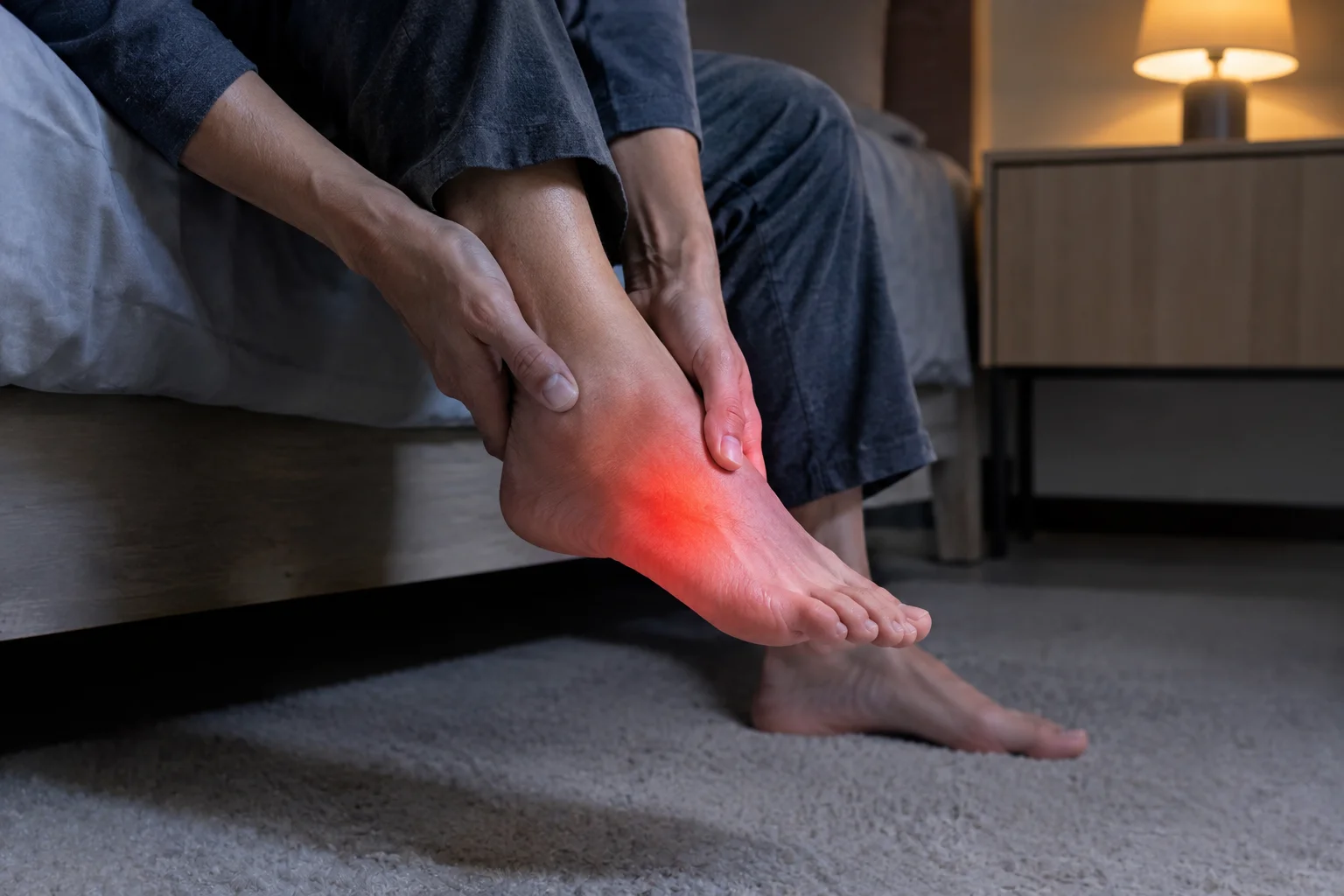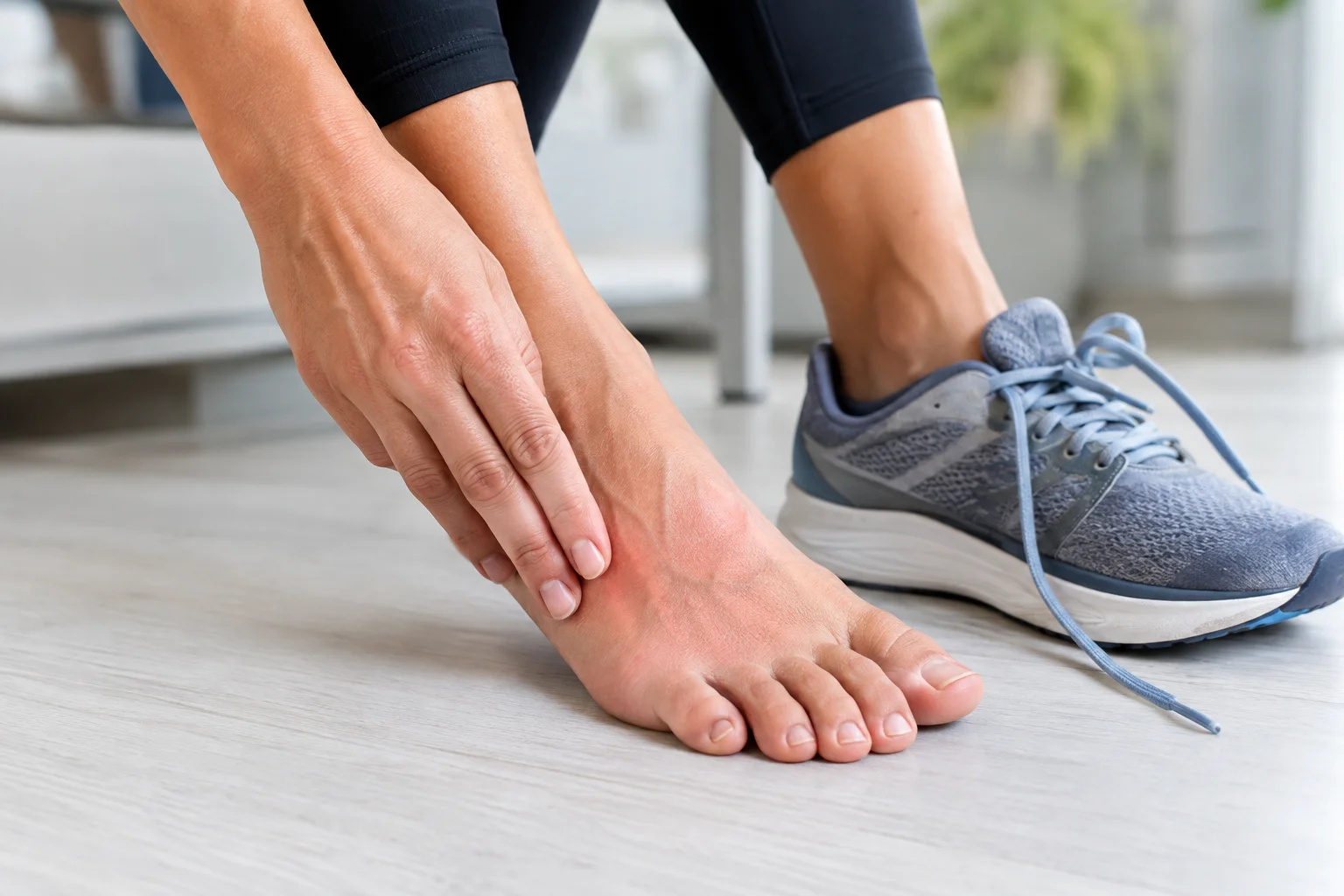
Pain Location Is the Strongest Clue
The foot is a complex structure with 26 bones, 33 joints, and over 100 muscles, tendons, and ligaments. When something goes wrong during running, the location of the pain narrows the diagnosis significantly.
| Where It Hurts | What It Feels Like | Most Likely Condition | Concern Level |
|---|---|---|---|
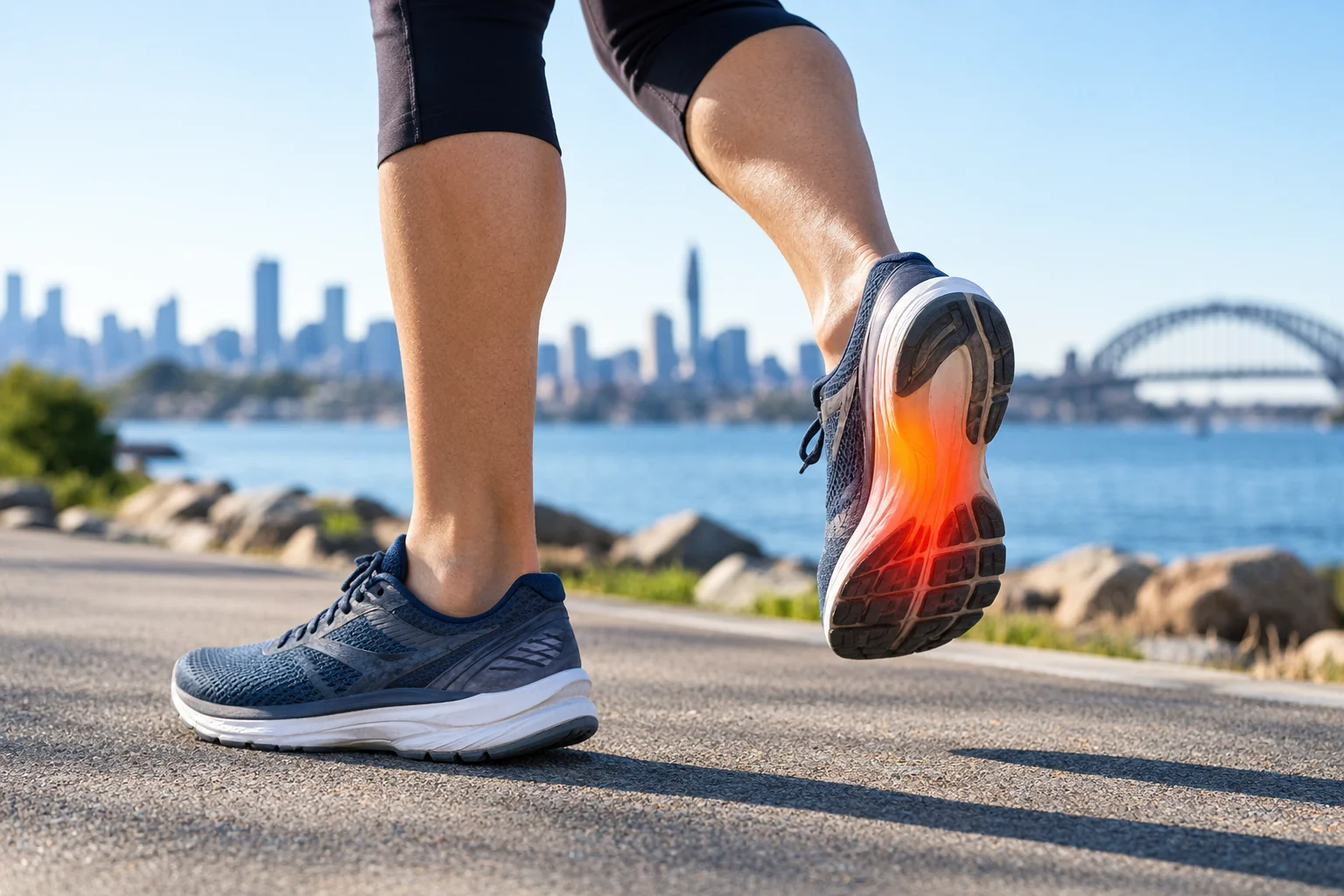
| Under the heel (plantar surface) | Sharp or stabbing pain, worst with first steps in the morning or after sitting, eases with movement then returns after long runs | Plantar fasciitis or heel spur | Moderate: treatable but worsens without intervention |
| Through the arch | Aching, pulling, or cramping along the inner arch, worse during push-off | Plantar fascia strain, posterior tibial tendon dysfunction, or arch fatigue | Moderate: biomechanical cause needs addressing |
| Ball of the foot (under metatarsal heads) | Burning, aching, or sharp pain under the forefoot, feels like stepping on a stone | Metatarsalgia, Morton’s neuroma, or metatarsal stress fracture | Moderate to high: stress fracture needs prompt diagnosis |
| Top of the foot | Aching or sharp pain on the dorsal surface, worse when lacing shoes tightly or pushing off | Extensor tendonitis, metatarsal stress fracture, or midfoot joint irritation | Moderate to high: stress fracture must be ruled out |
| Back of the heel or lower calf | Stiffness and aching in the Achilles tendon, worse at the start of a run, may ease then return after | Achilles tendonitis or tendinopathy | Moderate: progressive condition that worsens without load management |
| Side of the heel (lateral) | Pain on the outer edge of the heel, worse on uneven surfaces or cambered roads | Peroneal tendonitis or lateral heel stress | Moderate: often biomechanical and footwear-related |
| Toes (big toe joint) | Stiffness, aching, or sharp pain at the base of the big toe during push-off | Hallux limitus (stiff big toe), sesamoiditis, or early bunion irritation | Moderate: affects push-off mechanics and running efficiency |
A sports podiatrist uses this location-based assessment as the starting point, then examines your gait, foot structure, training history, and footwear to confirm the diagnosis and identify the underlying cause.

The Four Most Common Running Foot Injuries
These four conditions account for the vast majority of running-related foot pain presentations at Sydney Foot Doctor.
1. Plantar Fasciitis (Heel and Arch Pain)
Plantar fasciitis is the most common cause of heel pain in runners. The plantar fascia is a thick band of tissue running from the heel bone to the base of the toes, supporting the arch during every step. Running places repetitive tensile load on the fascia with every foot strike, and when the load exceeds the tissue’s capacity to recover, micro-tears and inflammation develop.
What it feels like: Sharp, stabbing pain under the heel, typically worst with the first steps in the morning. The pain may ease as the foot warms up, then return during or after a long run. Standing after prolonged sitting also triggers it.
What causes it in runners: Sudden increase in training volume or intensity, overpronation that increases medial arch strain, tight calf muscles that limit ankle dorsiflexion, running on hard surfaces, and worn-out shoes that no longer provide adequate cushioning and support.
What helps: Custom orthotics to support the arch and redistribute load, calf stretching and strengthening, shockwave therapy to stimulate tissue healing, appropriate footwear, and training load modification. For detailed treatment options, read the heel spur treatment guide (plantar fasciitis and heel spurs are closely related conditions).
2. Achilles Tendonitis (Back of Heel and Lower Calf)
The Achilles tendon connects the calf muscles to the heel bone and absorbs forces of up to 8 to 12 times body weight during running. When the load exceeds the tendon’s capacity, it becomes inflamed (tendonitis) or undergoes degenerative changes (tendinopathy).
What it feels like: Stiffness and aching at the back of the heel or lower calf, typically worst at the start of a run. It may ease as the tendon warms up, then return after the run or the next morning. In more advanced cases, the tendon is visibly thickened and tender to squeeze.
What causes it in runners: Rapid increase in hill running or speed work, tight or weak calf muscles, overpronation, low-drop shoes without adequate transition time, and insufficient recovery between hard sessions.
What helps: Load management (reducing running volume and intensity), eccentric calf strengthening exercises, orthotic therapy to control pronation and reduce tendon strain, laser therapy to reduce inflammation, and gradual return to full training. The Achilles tendonitis treatment guide covers the full management approach.
3. Metatarsalgia (Ball of Foot Pain)
Metatarsalgia is a general term for pain under the metatarsal heads (the ball of the foot). Running concentrates force through the forefoot during the push-off phase, and excessive or uneven loading on the metatarsal heads causes pain and inflammation.
What it feels like: Burning, aching, or sharp pain under the ball of the foot, often described as feeling like stepping on a pebble or a fold in the sock. Worse during the push-off phase of running and when wearing thin-soled shoes.
What causes it in runners: Excessive forefoot loading from a forefoot or midfoot strike pattern without adequate conditioning, tight calf muscles that shift load forward, high arches that concentrate pressure on the heel and ball of foot, bunion deformity shifting load laterally, and shoes with insufficient forefoot cushioning.
What helps: Custom orthotics with metatarsal doming to redistribute forefoot pressure, footwear assessment to ensure adequate cushioning, calf flexibility work, and gait analysis to identify loading patterns.
4. Stress Fractures (Top of Foot, Ball of Foot, or Heel)
A stress fracture is a small crack in a bone caused by repetitive loading that exceeds the bone’s ability to repair itself between sessions. In runners, the metatarsal bones (particularly the second and third) are the most common location, followed by the calcaneus (heel bone) and the navicular (midfoot).
What it feels like: A deep, localised ache that worsens progressively with running and does not ease with warming up (unlike tendon injuries). The pain is present during weight-bearing activity and reduces at rest. The area may be swollen and tender to direct pressure on the bone.
What causes it in runners: Training load errors (too much volume, too fast an increase, insufficient rest days), low bone density, nutritional deficiencies (calcium, vitamin D), biomechanical overload on specific bones, and running in shoes that no longer absorb impact.
What helps: Immediate rest from running (stress fractures worsen with continued loading and can progress to complete fractures). Imaging (X-ray or MRI) to confirm the diagnosis. Protected weight-bearing during healing. Addressing the underlying cause (training errors, biomechanics, nutrition, footwear) before returning to running.
“The most important thing a runner can learn is the difference between discomfort and injury. Muscle fatigue, mild soreness after a hard session, and temporary tightness are normal. Pain that is sharp, localised, present at the start of every run, or getting worse session after session is not normal. That is your body telling you something is failing, and continuing to run through it turns a treatable problem into a serious one.”
What Drives Most Running Foot Injuries
Regardless of the specific condition, running foot injuries are usually driven by one or more of the same underlying factors.
Training load errors are the single most common cause. Increasing weekly distance by more than 10 percent, adding speed work or hills without adequate base, running hard sessions back to back without recovery days, and returning to running too quickly after a break all overload tissues that have not had time to adapt.
Biomechanical imbalances determine which tissues are overloaded. Overpronation increases strain on the plantar fascia, posterior tibial tendon, and medial forefoot. Supination concentrates load on the lateral foot and Achilles. High arches reduce the foot’s natural shock absorption. Flat feet increase medial joint stress. A biomechanical assessment identifies your specific pattern.
Footwear problems compound biomechanical issues. Shoes that have exceeded their mileage (most running shoes lose significant cushioning and support after 600 to 800 kilometres), shoes that are wrong for your foot type and gait, and shoes that are too small (feet swell during running, particularly on longer runs) all contribute. A footwear assessment ensures your shoes match your foot and your running.
Insufficient flexibility and strength in the calf complex, foot intrinsic muscles, and hip stabilisers increase the load on passive structures (bones, fascia, tendons) that are not designed to bear it alone. Targeted strengthening and flexibility work prescribed by your podiatrist addresses these deficits.
When to Run Through It vs When to Stop
Not every ache during running requires stopping. But some do.
| Symptom | Run Through It? | Action |
|---|---|---|
| General muscle fatigue or mild soreness after a hard session | Yes | Normal training response. Ensure adequate recovery before the next hard session. |
| Tightness that eases within the first five to ten minutes of running | Usually yes | Monitor. If it is present at the start of every run, it may be an early warning. |
| Sharp, localised pain at a specific point on the foot | No | Stop the run. This suggests a specific tissue is failing. Assessment needed. |
| Pain that gets worse during the run (does not ease with warming up) | No | Stop. Pain that escalates during running indicates load exceeding tissue tolerance. |
| Pain present before, during, and after running that is getting worse each session | No | Stop running and book a podiatry appointment. Progressive pain indicates an injury that is worsening. |
| Swelling, visible bruising, or inability to walk normally after running | No | Stop immediately. May indicate a stress fracture, tendon tear, or significant tissue damage. |
If you are unsure, reduce your running volume and intensity for a week. If the pain resolves, it was likely a load management issue. If it persists or returns when you increase again, professional assessment is needed.
How a Sports Podiatrist Helps Runners
A sports podiatrist at Sydney Foot Doctor assesses running injuries with a focus on getting you back to running safely, not just resolving the immediate pain.
Diagnosis confirms which structure is injured and how severe the injury is. This may involve clinical examination, gait analysis (watching you walk and, where appropriate, run), and referral for imaging (X-ray, ultrasound, or MRI) if a stress fracture or tendon tear is suspected.
Cause identification determines why the injury occurred. Training history, biomechanical assessment, footwear evaluation, and flexibility and strength testing identify the factors that overloaded the injured tissue.
Treatment addresses both the injury and its cause. Custom orthotics or sports insoles correct biomechanical overload. Shockwave therapy or laser therapy accelerate tissue healing. Stretching and strengthening programs address flexibility and muscle deficits. Footwear recommendations ensure your shoes support rather than hinder recovery.
Return-to-running plan provides a structured, graduated return to full training that allows the injured tissue to adapt to increasing load without re-injury. Jumping straight back to full volume is the most common cause of re-injury in runners.
Contact Sydney Foot Doctor to book a running injury assessment at any of our eight Sydney clinics.